

Introduction to Image Search Techniques
Nowadays, it is possible to index, scrape, and even deepfake brand images within a few seconds of their publishing. Hacking of the product renders, infographics or executive headshots can undermine your search engine and mislead the customers.
This is the ultimate manual that tech experts consider in 2026 in securing their visual property.
The Brand Protection Stack of the Professional.
1. Multi-Engine Reverse Indexing.
Don’t rely solely on Google. In order to locate 99% of unauthorised uses, you must have a multi-layered approach:
- Google Lens: Most useful in finding products, landmarks and shopping matches.
- TinEye: The standard of the industry when it comes to the fingerprinting of images; the algorithm can match pixels even cropping or editing of the image occurred.
- Yandex Images: Can be useful in cases of facial recognition and in locating matches in Eastern Europe and Asia that Google would fail to detect.
- Lenso.ai: AI content auditor, which classifies findings into People, Places and Duplicates, it is easy to identify copyright infringements | Image Search Techniques
2. Lenso.ai: The AI Content Auditor.
Lenso.ai became a popular business favourite in 2026. It categorises the results in People, Places, and Duplicates, which then makes the Duplicates tab a treasure trove to detect the infringement immediately.
3. Red Points: Scalable Brand Monitoring.
Searching on an enterprise scale cannot be done manually. Red Points is an automated system that crawls the marketplaces such as Amazon and social networks such as Instagram in real-time and detects misuse of logos automatically.
4. Digimarc: Invisible Digital Watermarking.
Conventional watermarks can be cut or eliminated. Digimarc inserts a digital signal into the pixel data within an invisible way. That signal can be cropped, resized and file-format converted, and hence you can find a leak by tracing it to its origin.
5. Metadata Scrubbing and Injection
You are an SEO specialist and know that EXIF data are useful in rankings. Insert the copyright information of your brand in the picture metadata before posting. When a person scrubs the picture, they tend to drag that metadata over, providing an obvious evidence of proprietorship | Image Search Techniques

Image search methods are at their advanced stage.
Technique 2: The first search technique is called the Visual Crop Search.
In more complicated pictures like the one of lifestyles with your product, use Bing Visual Search. Isolating your logo or product just by use of crop features it will force the algorithm to ignore the rest of the image and only match the asset you want to protect | HiMovies
Technique 2: LSI Keyword and Brands Term Cross-Referencing.
Reverse Image Search Techniques lacks most applications. Text search in Google Images Your Brand Name + Product + Latest. Pirates tend to overpost their own image of your product; it can be located through a keyword-based search where reverse search fails to | Image Search Techniques
Technique 3: Monitoring the use of AI Metadata by Super Fakes.
In 2026 fakers come up with your photos in variations with the help of AI. Flick the C2PA (Coalition for Content Provenance and Authenticity) manifest. In case an image purports to belong to you yet it does not contain your cryptographic signature, it is a fake.
SEO Strategy for Visuals
- Name SEO: Replace IMG with brand-product-model-2026.webp.
- Schema Markup: Introduce ImageObject schema with copyrightHolder property specified.
- Alt-Text Specificity: You should not merely describe the picture, but you should also add your brand name, in order to associate the image with your realm.
Image Search Techniques in 2026: The Ultimate Guide.
In 2026, searching an image does not consist of typing keywords. Image Search Techniques is an effective tool in SEO practise, news coverage, and technology lovers as it is provided by multimodal AI and visual intelligence. These elaborate methods are necessary whether you are on the hunt of a viral meme generator or locating high-res Blog content | Image Search Techniques
The first step is an Advanced Reverse Image Search Techniques (Beyond the Basics).
Image verification is based on reverse search. We apply a multi-engines strategy in 2026 to achieve the best consistent results | Image Search Techniques
- Google Lens (The Entity Finder): Ideal in identifying products, plants or landmarks. The original high-res original is located with the philtre of Exact Match.
- TinEye (The Digital Forensic): Monitor assets; this displays the first time an image was made and it can be modified.
- Yandex and Baidu: Entitled to find sources of information or faces that could be overlooked by Western search engines due to the international nature | State Wide Area Network
Step 2: Visual Search with AI Powered.
The visual search is now integrated into our devices. Here’s how to use it like a pro:
- Visual Look-Up (iOS/Android): Visual Look-Up: This is a feature of your phone that allows you to recognize an item directly in your gallery without having to upload it to a service.
- Cropping to Specificity: In Bing Visual Search, crop a particular area (e.g. a watch on a wrist). The AI disregards the others and locates the one product only.
- Same Energy (Vibe Search): Find images by applying AI philtres that find pictures by aesthetic or mood instead of a single pixel- good when a designer wants to create similar images | Image Search Techniques
Step 3: Image Search Techniques to SEO Experts.
To have your site pictures ranking, you need to know how they will be interpreted by the search engines in 2026.
- Search Engines can now read EXIF data: Object-Level Metadata. Make sure that your original pictures are copyrighted and their origin is written.
- Contextual Placement: Image Close to high relevancy text. The AIs in use by Google now analyse the context of the surrounding paragraphs to come up with the intention of the image.
- Schema Markup (ImageObject): JSON-LD schema is used to recognise the image as a product, recipe, or original work of art | Image Search Techniques
Step 4: The fourth step is verification and Fact-Checking.
Verification is essential at the age of deepfakes and AI-generated content.
- About This Image: This is a new tool of Google which displays the age of an image and the history or news of fact-checking.
- Metadata Analysis: Metadata detects the presence of AI-generated content by looking at C2PA manifests or watermarks | croxyproxy
- Time Filtering: The Time down in the Google search results will allow you to locate the latest date that a site was indexed; this is useful in detecting misinformation | Image Search Techniques
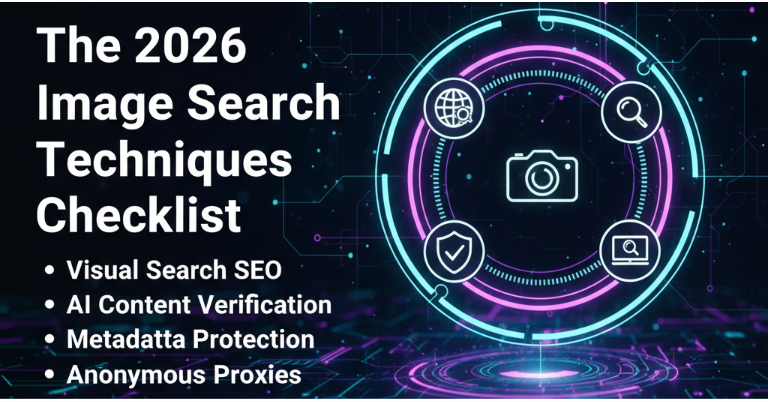
The 2026 Image Search Techniques Checklist
- SOCKS5 proxies can be used to search anonymously.
- Check-in with the Brave Browser to block tracking codes on mirror search engines.
- It is always important to cross-reference the results that are obtained with at least three engines.
- Be sure that the material is under Creative Commons (CC) license before using it | Image Search Techniques
(FAQS)
Q1 How to identify the people who use my images without my consent?
A: TinEye is the best tool to use in terms of precise matches of pixels and Google Lens is used in terms of visual changes on social media and news sites | Image Search Techniques
Q2: Could reverse image search be 100 percent true in 2026?
A: The accuracy is quite specific in the case of an exact match, and AI-generated “Super Fakes” may sometimes be able to circumvent regular philtres. These should be AI-native tools such as Lenso.ai, which are more precise.
Q3: Does the right-click disabling in fact deter the image theft?
A: No. It can be circumvented by tech savvy users through inspection elements or screenshots. Instead, look at Focus on Digital Watermarking (Digimarc) that secures the file itself | Image Search Techniques
Q4: What is the value of image search in SEO of my Web site?
A: Your original images are used and referenced (through a backlink) and this enhances your authority in a domain. Image Search Techniques will assist you in finding the unlinked mentions which you can contact and ask to be linked.
Q5: What does Image Fingerprinting mean?
A: It is a method employed by such tools as TinEye to design a distinctive digital signature of a picture, depending on its visual content, as opposed to its title, or metadata | Image Search Techniques
Q6: Is image search possible to locate fake products?
A: Yes. As a way of locating marketplace listings (such as on Alibaba or eBay), you can post a photo of your real product, after which the site will provide you with a list of listings using your official photos to promote fakes.
Q7: Can I use the image of another person provided that I make changes?
A: As a rule, no. Modification does not predeterminately give out fair use. Copyright laws in 2026 are quite stringent with respect to so called derivatives works based on original brand properties.
Q8: Which is the safest image searcher with the help of the browser?
A: Brave or Hardened Firefox are the most suitable. They stop the trackers of third party search engines profiling the search behaviour of your brand.
Q9: What can I do to safeguard the use of the logo of my brand?
A: Establish automatic notifications with the help of a tool such as BrandShield. It crawls the Internet finding your logo in the illegal domains or on the social networks in the fake accounts.
Question 10: Is it possible to copyright AI-generated images?
A: The laws evolve continuously even in 2026, nonetheless, in general, the purely AI-generated images do not have a human author. But when you edit your brand assets with AI, then it is safeguarded.
The 2026 Visual Protection Checklist (Quick Recap)
| Feature | Tech-Expert Recommendation | Why it matters? |
| Watermarking | Invisible Digital Signal (Digimarc) | Cropping se khatam nahi hota. |
| Search Engine | Multi-Engine (TinEye + Yandex + Lens) | 100% coverage ke liye zaroori hai. |
| SEO Signal | JSON-LD Image Schema | AI ko “Source of Truth” batane ke liye. |
| Privacy | SOCKS5 Proxies for Auditing | Competitors ko pata chale bagair audit karne ke liye. |
Final Takeaway: Your Visual Defense Strategy for 2026
In 2026, brand protection has shifted from passive observation to active digital forensics. As an SEO expert, you must recognize that your brand’s visuals are no longer just “pictures”they are data entities that carry your reputation across a fragmented AI ecosystem.
The core takeaway for 2026 is the “Zero-Trust Visual Architecture.” You should never assume your images are safe just because they are on your server. Instead, you must build a defense-in-depth strategy that makes your visuals “self-protecting” and “self-identifying.”
1. The Proactive “Crawl & Conquer” Mindset
Gone are the days of manually checking Google Images once a month. To stay ahead of counterfeiters and “Super Fakes,” your workflow must be automated.
- The Action: Deploy AI-driven monitoring tools like Red Points or Tracer that scan global marketplaces, social media, and even decentralized Web3 spaces 24/7. These tools don’t just find matches; they initiate automated takedowns, saving your brand from revenue leakage before it scales.
2. Implementation of Cryptographic Provenance
In an era dominated by Generative AI, search engines like Google and Bing prioritize content that can prove its origin.
- The Action: Adopt the C2PA (Coalition for Content Provenance and Authenticity) standard. By embedding a cryptographic “manifest” into your brand assets, you provide an immutable record of who created the image and when. This not only prevents deepfakes but also boosts your E-E-A-T (Experience, Expertise, Authoritativeness, and Trustworthiness) in search rankings | Image Search Techniques
3. Turning Protection into SEO Profit
Brand protection shouldn’t just be a cost center; it’s a high-value Link Building opportunity.
- The Action: Use TinEye or Lenso.ai to find “Unlinked Brand Mentions.” When you find a high-authority blog using your infographic or product shot without credit, don’t just send a takedown notice. Instead, request a canonical backlink. This transforms “theft” into a powerful SEO signal that drives your domain authority higher | Image Search Techniques
The 2026 Brand Protection Checklist (Technical Summary)
| Security Layer | Recommended Tool/Technique | Strategic Benefit |
| Identity Proof | C2PA Metadata / SynthID | Proves the image is an authentic human-made brand asset. |
| Traceability | Invisible Watermarking (Steg.AI) | Allows you to trace the exact source of an internal leak. |
| Monitoring | AI Brand Monitoring (Red Points) | Scalable, real-time detection across thousands of global platforms. |
| SEO Authority | JSON-LD ImageObject Schema | Directly tells AI search engines that you are the owner. |






Leave a Reply