
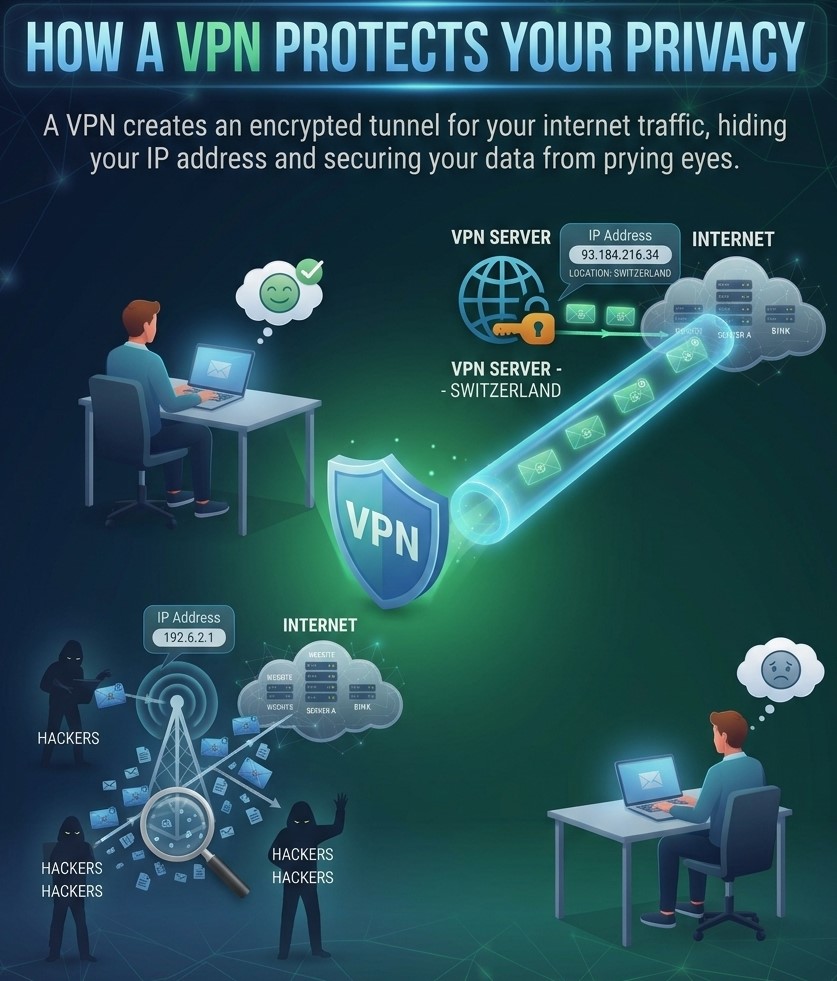
Intruduction of how does a VPN protect your privacy
If you’ve ever felt uneasy knowing your internet provider, your favorite apps, or even the coffee shop Wi-Fi you just connected to could be watching what you do online, you’re not imagining things. Data collection has become the default setting of the internet, not the exception. That’s exactly why more than a billion people worldwide now rely on a VPN (Virtual Private Network) as a basic part of their digital routine — not as some niche tool for tech experts, but as everyday protection, the same way you’d lock your front door.
But how does a VPN actually protect your privacy? What’s really happening behind the scenes when you tap “Connect”? In this guide, we’ll break down exactly how VPN encryption works, what it hides, what it doesn’t, and what to look for in a VPN in 2026 if privacy is your main priority.
What a VPN Actually Does
At its core, a VPN creates an encrypted tunnel between your device and a remote server operated by the VPN provider. Instead of your data traveling in a way that’s readable by your internet service provider (ISP), network administrators, or anyone snooping on public Wi-Fi, it travels inside this tunnel, scrambled into unreadable code.
Two things happen simultaneously:
- Your IP address is hidden. Websites and services see the VPN server’s IP address instead of yours, making it far harder to trace activity back to your device or location.
- Your traffic is encrypted. Even if someone intercepts your data mid-transit, all they see is gibberish, not your passwords, messages, browsing history, or personal details.
Think of it like sending a letter in a locked box through a private courier, instead of a postcard anyone along the way could read | Tamilyogi VPN
The Encryption Behind the Scenes
Encryption is the real engine of VPN privacy. Most reputable VPNs today use AES-256 encryption, the same standard used by banks, governments, and militaries. Combined with modern tunneling protocols like WireGuard, OpenVPN, or Lightway, this encryption is applied at high speed without noticeably slowing your connection — a major shift from the sluggish VPNs of a decade ago | How does a VPN protect your privacy
What’s new in 2026 is the growing rollout of post-quantum encryption by leading VPN providers. As quantum computing edges closer to being able to crack today’s encryption standards, top VPN services have started integrating quantum-resistant algorithms (such as ML-KEM) to future-proof user data against tomorrow’s threats, not just today’s. This is one of the clearest signs that VPN privacy protection isn’t standing still — it’s evolving alongside the threats it defends against | How does a VPN protect your privacy
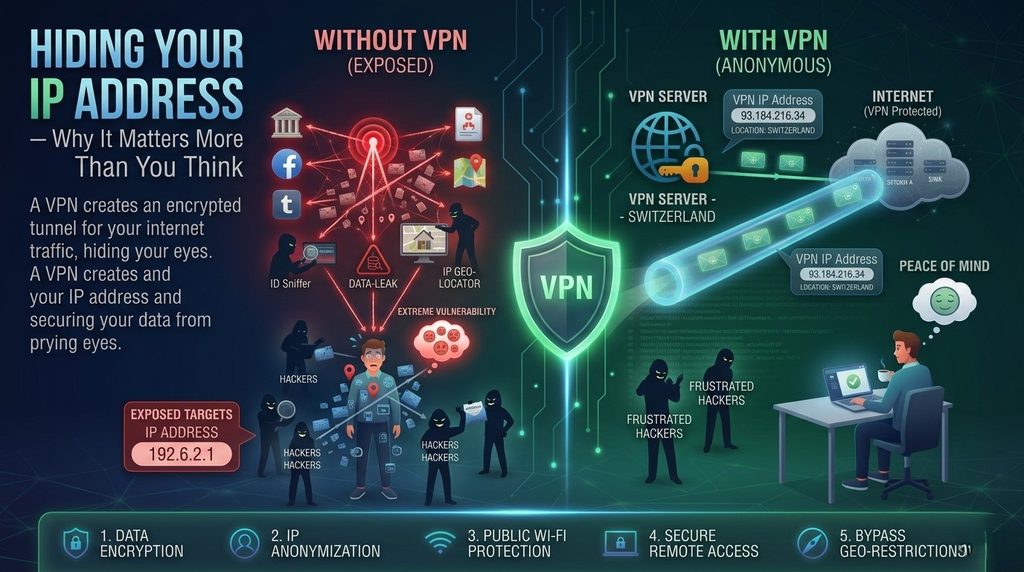
Hiding Your IP Address — Why It Matters More Than You Think
Your IP address isn’t just a random string of numbers. It can reveal your approximate location, your ISP, and it acts as a unique identifier that advertisers, trackers, and sometimes malicious actors use to build a profile of your online behavior over time | How does a VPN protect your privacy
When you connect through a VPN, your real IP is replaced with the VPN server’s IP. This means:
- Websites can’t easily pinpoint your physical location.
- Your ISP can see that you’re connected to a VPN, but not what you’re doing inside that tunnel.
- Advertisers have a much harder time linking your activity across different sites and sessions.
This is also why many people use VPNs to access region-locked content or bypass local censorship — although it’s worth being clear that using a VPN to protect your privacy is very different from using one to access pirated or illegal content, which carries its own legal risks regardless of the tool involved | How does a VPN protect your privacy
Protecting You on Public Wi-Fi
Public Wi-Fi — airports, cafés, hotels, libraries — is convenient, but it’s also one of the easiest places for data interception. Many public networks have little to no security, meaning anyone with basic tools on the same network could potentially intercept unencrypted data.
A VPN neutralizes this risk almost entirely. Because your traffic is encrypted before it even leaves your device, it doesn’t matter how insecure the Wi-Fi network itself is — your data stays private as it travels through the tunnel | How does a VPN protect your privacy
This is one of the most practical, everyday privacy benefits of a VPN, and it’s a big reason remote workers, digital nomads, and frequent travelers treat VPNs as non-negotiable in 2026.
No-Logs Policies: The Privacy Promise That Actually Matters
Encryption protects your data in transit, but what happens to your data once it reaches the VPN provider’s servers? This is where no-logs policies come in.
A genuine no-logs VPN doesn’t record your browsing activity, connection timestamps, IP addresses, or DNS queries. In theory, even if a government or third party legally demanded user data from the provider, there would be nothing meaningful to hand over | How does a VPN protect your privacy
The catch is that “no-logs” is just a marketing claim unless it’s backed up by:
- Independent third-party audits that verify the no-logs claim technically, not just contractually.
- RAM-only server infrastructure, which stores no data on physical hard drives and wipes everything on every reboot.
- A privacy-friendly jurisdiction, ideally outside intelligence-sharing alliances like the Five Eyes, Nine Eyes, or Fourteen Eyes networks, where legal pressure to share user data is lower.
In 2026, this transparency has become the real dividing line between VPNs that genuinely protect privacy and ones that simply advertise it | How does a VPN protect your privacy
Kill Switches and Leak Protection
Privacy protection isn’t just about what happens when the VPN is working — it’s about what happens if it fails. A dropped VPN connection, even for a second, could expose your real IP address if there’s no safety net in place.
This is where a kill switch comes in. A kill switch automatically cuts your device’s internet access the moment the VPN connection drops, preventing any unprotected data from leaking out until the secure connection is restored. Modern kill switches now react in milliseconds, making accidental exposure extremely rare | How does a VPN protect your privacy
Alongside this, quality VPNs also guard against:
- DNS leaks — where your DNS requests bypass the VPN tunnel and reveal your browsing activity to your ISP.
- IPv6 leaks — where dual-stack systems expose your real IP despite being connected to a VPN.
- WebRTC leaks — a browser feature that can inadvertently reveal your real IP during video/audio calls.
Together, these protections close the small gaps that could otherwise undermine everything else a VPN does.
VPNs vs. Proxies: A Quick Privacy Comparison
It’s worth briefly addressing a common point of confusion, since it directly affects privacy. A proxy server can also mask your IP address, but it typically doesn’t encrypt your traffic the way a VPN does. That means a proxy might hide where your traffic is coming from, but it usually won’t protect the actual content of that traffic from being intercepted | How does a VPN protect your privacy
For genuine privacy protection — not just IP masking — a VPN is the far stronger tool, precisely because encryption is built into how it works from the ground up.
Why VPN Privacy Matters More in 2026
A few forces are converging right now that make VPN-based privacy protection more relevant than ever:
- Rising cyberattacks targeting network infrastructure. Security researchers have tracked a sharp increase in attacks exploiting vulnerabilities in edge devices and VPN appliances themselves, which is a strong reminder that not all VPNs are created equal — provider security matters as much as user-side encryption.
- Expanding digital surveillance and data collection. Awareness around how much personal data is collected by advertisers and platforms continues to grow, and a large share of internet users now say they feel they have little control over how their information is used | How does a VPN protect your privacy
- New privacy-related legislation. Regulatory proposals in various regions continue to test the boundaries between lawful access and weakening encryption for everyone, keeping VPNs and encrypted tools at the center of ongoing privacy debates.
- Bundled security ecosystems. VPN providers are increasingly merging VPN, antivirus, and identity protection into single privacy suites, reflecting a broader shift toward treating privacy as a layered, everyday necessity rather than a one-time fix.
What to Look for in a Privacy-Focused VPN
If your main priority is privacy — not just streaming or unblocking content — here’s a practical checklist:
- Independently audited no-logs policy — not just a claim on the homepage.
- AES-256 encryption with modern protocols like WireGuard.
- RAM-only servers for zero data retention.
- A kill switch that activates instantly | How does a VPN protect your privacy
- DNS, IPv6, and WebRTC leak protection built in by default.
- Privacy-friendly jurisdiction, ideally outside major surveillance alliances.
- Transparent, regularly published security audits and incident disclosures.
A VPN that checks these boxes is doing far more than just changing your visible IP address — it’s building a genuine privacy layer around your entire online presence | How does a VPN protect your privacy
Final Thoughts
A VPN protects your privacy through a combination of strong encryption, IP masking, strict no-logging practices, and safeguards like kill switches and leak protection working together. It’s not a single feature but a whole system designed to keep your data unreadable, your identity harder to trace, and your online activity out of reach from ISPs, advertisers, and anyone else who might be watching | How does a VPN protect your privacy
As surveillance, cyber threats, and data collection all continue to grow in 2026, understanding exactly how this protection works — rather than just trusting a logo or a marketing claim — is the first real step toward taking control of your own online privacy.



Leave a Reply